


Departures Podcast featuring Volodymyr Ishchenko, author of ‘Towards the Abyss: Ukraine from Maidan to War’
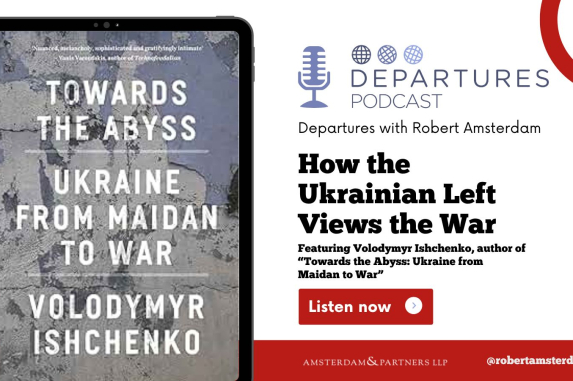
The tremendous velocity of history that Ukraine has experienced since independence to the Maidan revolution to the catastrophic war brought on by Russia’s aggression often tends to be sold and told in neatly packaged narratives to the West – a heroic tale of a plucky democracy breaking from from the yoke of an authoritarian past. […]


Departures Podcast featuring CY Huang

It was just three years ago when the Economist magazine ran a cover story on Taiwan, describing it as “the most dangerous place in the world.” With intensifying competition with China and deteriorating global security following Russia’s invasion of Ukraine, there are many arguments that continue to support that negative outlook. But that’s not the […]
The Slings and Arrows of Defending a Church in Wartime Ukraine
It’s probably not a good use of time responding to Twitter users such as @officejjsmart @JayinKyiv et al., but these people are simply not telling the truth. Lies and dishonesty sometimes should be confronted instead of ignored. I’m no “pal” of Tucker Carlson. The ony time I’ve ever spoken with him was during that interview. […]
Departures Podcast featuring Nicolai Petro, author of ‘The Tragedy of Ukraine’
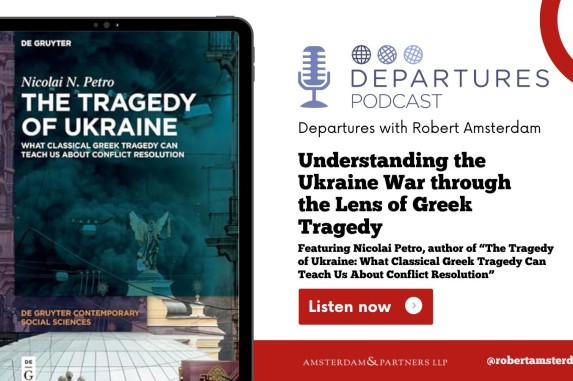
As the war in Ukraine rages on into its second year, there remains little consensus or understanding of how the conflict could be resolved outside of military outcomes, and a persisting misunderstanding on behalf of the West regarding Ukraine’s own internal preexisting social divisions. This week we’re pleased to have a special guest, Dr. Nicolai […]
Departures Podcast featuring Karl Schlögel, author of “The Soviet Century: Archaeology of a Lost World”

From the Russian Revolution of 1917 to the chaotic disintegration of the Soviet Union in 1991, there is a dazzling and disorienting array of histories. While many books detail the lives and politics of Soviet leaders, Karl Schlögel invites us to better understand the experience of the country through the lives lived by more common […]
Departures Podcast featuring Oren Kessler, author of ‘Palestine 1936’

There is a strong argument to be made that the root of Palestinian identity can be traced back to the 1936-1939 Great Revolt, which united rival families and communities, melded urban with rural, and joined rich and poor together in a struggle against Zionism and the British Empire. This is the starting point in Oren […]




Russia News Blast
-
RA’s Daily Russia News Blast – February 24, 2022

Today in Russia: Invasion. Will the world respond?
» Read More -
RA’s Daily Russia News Blast – February 23, 2022

Today in Russia/CIS: Ukraine calls up reservists; Levada Center Director Volkov on public opinion in Russia; Erdogan says Turkey won’t accept Russian moves in Ukraine; EU and US latest sanctions; Russia-Ukraine crisis as viewed Uzbekistan; Israel walks a tightrope on its Ukraine position
» Read More -
RA’s Daily Russia News Blast – February 22, 2022

but which borders?;’ History professor (and President) Putin delivers fiery speech; Lavrov re-writes the rules of international sovereignty; UK and EU roll out initial sanctions, and Washington plans big moves; Nord Stream 2 finally meets its end after a slow, painful death; Zelensky’s speech; White House: On second thought, that’s an invasion; How will China respond?; Russia to evacuate all diplomatic staff from Ukraine
» Read More - » More
